Showing posts sorted by relevance for query scaffolding. Sort by date Show all posts

January 29, 2011

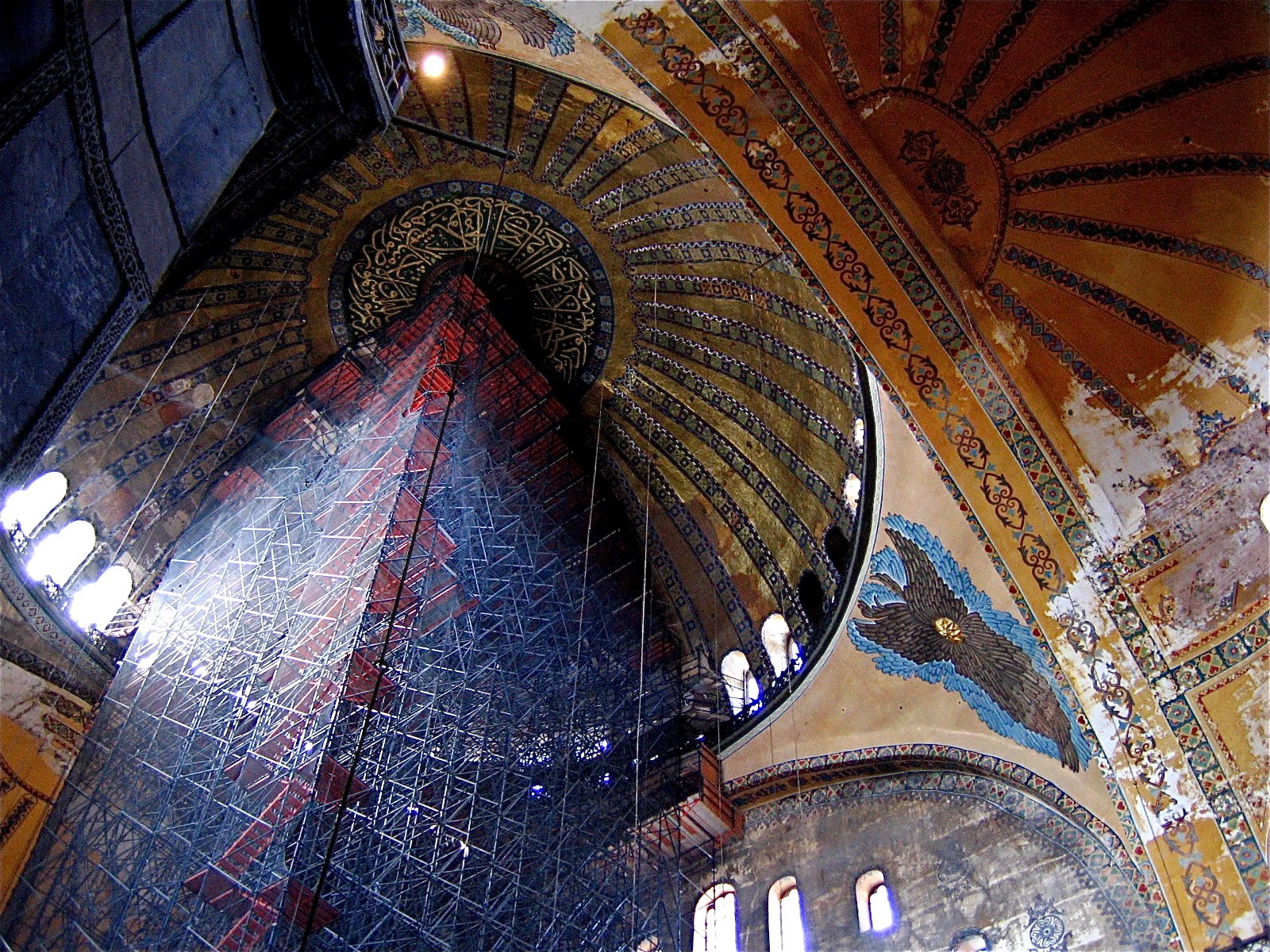
Aya Sofia, Istanbul. June, 2007


Scaffolding. A given in just about every vacation I’ve ever taken. Something somewhere is bound to be “under restoration.” In Italy, I’ve come across so many “in restauro” signs (on closed buildings, on museum walls in spaces normally occupied by paintings, etc.) that I used to joke with a friend that the museum in the town of Restauro must be chock full of the best paintings in the world. The certainty of restoration has become almost laughable now, and a good thing it has, because scaffolding and repairs are inevitable. Notre Dame in Paris. The Vatican’s Sistine Chapel. The Prado in Madrid. Less so in the USA, but then we’re not as old as those other places and need fewer facelifts, it seems. Above, the scaffolding within one of the oldest buildings in the world (dedicated in the year 360; not a typo), the big and beautiful Aya Sofia (current structure dates from 532; also not a typo.) First a church, then a mosque, now a museum, this building has seen it all, survived it all. Wars (holy and otherwise), schisms, revolutions, earthquakes...and it’s still standing, still welcoming visitors throughout the passing years. And, frankly, because the interior is such an eclectic mix of Christian and Muslim, secular and religious imagery, the scaffolding has a beauty all its own and somehow doesn’t look at all out of place.

January 29, 2017

Aya Sofia, Istanbul. June, 2007


Scaffolding. A given in just about every vacation I’ve ever taken. Something somewhere is bound to be “under restoration.” In Italy, I’ve come across so many “in restauro” signs (on closed buildings, on museum walls in spaces normally occupied by paintings, etc.) that I used to joke with a friend that the museum in the town of Restauro must be chock full of the best paintings in the world. The certainty of restoration has become almost laughable now, and a good thing it has, because scaffolding and repairs are inevitable. Notre Dame in Paris. The Vatican’s Sistine Chapel. The Prado in Madrid. Less so in the USA, but then we’re not as old as those other places and need fewer facelifts, it seems. Above, the scaffolding within one of the oldest buildings in the world (dedicated in the year 360; not a typo), the big and beautiful Aya Sofia (current structure dates from 532; also not a typo.) First a church, then a mosque, now a museum, this building has seen it all, survived it all. Wars (holy and otherwise), schisms, revolutions, earthquakes...and it’s still standing, still welcoming visitors throughout the passing years. And, frankly, because the interior is such an eclectic mix of Christian and Muslim, secular and religious imagery, the scaffolding has a beauty all its own and somehow doesn’t look at all out of place.

May 7, 2013

Paris. December, 2005


My first visit to the Pompidou Centre. It hadn’t existed during my last trips to Paris in 1969 and 1972. So I was doubly mesmerized by both the busyness of the structure’s tunnels and scaffolding, and by the tribute to Martin Scorsese. I remember showing this photo to my colleague Ed, a Scorsese fan. His very first reaction was, “Look at that pigeon!” I had no idea what he was talking about and I’d seen this photo dozens of times. Then I took a closer look. Can you see it?

June 2, 2020

Cannes. November, 2012


I’ve long gotten over my suspicion that once word gets out about my travel plans, all of the countries on my itinerary quickly decide to start major construction projects and send all of their important paintings out for restoration. Still, the coincidence of the appearance of scaffolding and the time of my arrival is higher than average. So I was happy to see this compromise in a church being restored in the old city section of Cannes. The protective barrier cloths that hang on each side of the church interior feature photographs of what you’d see if there were no construction happening. Nice touch.

January 11, 2019

Venice. October, 2012


Titian’s Assumption is my favorite painting in the world. It hangs in the place for which it was originally painted, above the main altar in the Franciscan church, Santa Maria Gloriosa dei Frari, in Venice. Back in the 1980s, when I visited the church on each trip to Venice, I’d duck in for a moment or two each time I passed by, always in awe of the painting’s quiet majesty and power. This past October, when I took Jay to experience it, well, you can see that it was covered with scaffolding. Still, just a peek here and there are visible, reminding me of past viewings, of how powerful this canvas remains. For a less obscured view of Titian’s masterpiece, click here.

June 2, 2014

Cannes. November, 2012


I’ve long gotten over my suspicion that once word gets out about my travel plans, all of the countries on my itinerary quickly decide to start major construction projects and send all of their important paintings out for restoration. Still, the coincidence of the appearance of scaffolding and the time of my arrival is higher than average. So I was happy to see this compromise in a church being restored in the old city section of Cannes. The protective barrier cloths that hang on each side of the church interior feature photographs of what you’d see if there were no construction happening. Nice touch.

May 7, 2019

Paris. December, 2005


My first visit to the Pompidou Centre. It hadn’t existed during my last trips to Paris in 1969 and 1972. So I was doubly mesmerized by both the busyness of the structure’s tunnels and scaffolding, and by the tribute to Martin Scorsese. I remember showing this photo to my colleague Ed, a Scorsese fan. His very first reaction was, “Look at that pigeon!” I had no idea what he was talking about and I’d seen this photo dozens of times. Then I took a closer look. Can you see it?

August 15, 2016

Venice, Italy. October, 2012


She is risen. Today is the Feast of the Assumption. And here is a view to my favorite painting in the world, Titian's Assumption, as seen hanging in the spot for which it was painted in the Franciscan church, Santa Maria Gloriosa dei Frari in Venice. (When I brought Dr. Blake to the Frari in 2012 to show him the painting, sadly it was obscured by some nasty scaffolding. Click here for an unobstructed view.) Here are some things I've always heard about this feast day that honors the physical assumption of the Blessed Virgin into heaven (Google for accuracy): That it was a bodily-related feast, established by Pope Pius XII after World War II to commemorate the vast amount of war-related human carnage. That many Italian-Americans and Irish-Americans believe there is a miraculous cure in the seas on this day, causing thousands to flock to the waters and dunk themselves in the allegedly healing brine. When I was a Catholic a long time ago, even I used to do this. But then again, I love ritual of any kind, especially those that are beach-related.

January 11, 2013

Venice, Italy. October, 2012


Titian’s Assumption is my favorite painting in the world. It hangs in the place for which it was originally painted, above the main altar in the Franciscan church, Santa Maria Gloriosa dei Frari, in Venice. Back in the 1980s, when I visited the church on each trip to Venice, I’d duck in for a moment or two each time I passed by, always in awe of the painting’s quiet majesty and power. This past October, when I took Jay to experience it, well, you can see that it was covered with scaffolding. Still, just a peek here and there are visible, reminding me of past viewings, of how powerful this canvas remains. For a less obscured view of Titian’s masterpiece, click here.